 |
| Image Credit: NASA/JPL/Space Science Institute/Errol Coder |

Wednesday, September 10, 2014
Cassini image composite of Saturn's North Pole

Tuesday, September 9, 2014
67P/C-G Comparing Shadows and Angles from Aug 15 and Sep 7
The time of day and angle of an image in photography can play a tricky part in the process of imaging. It can also reveal important information about a subject. Capturing images at different times of day which results in different shadow angles, as well as capturing them at slightly different angles changes the image significantly. The same goes for the Rosetta orbiter as it captures its images of comet 67P/C-G.
On August 15, 2014 an image of the comet that appears to be the end of the section typically designated as the "body." The sun was at an angle nearly straight on causing short shadowing on the surface. Only in areas with high crater walls were the effects of the shadows drastically present. A part of the comet typically called the "head" of the comet is seen in the distance past the "body" section on the left side of the lower left of the image.
 But, then today Rosetta again captured an image of the same area, but the sun itself was at a drastically different angle. This caused some interesting shadowing and made some areas that originally looked smoother, to appear rougher and more jagged. Additionally, due to the angle of illumination the "head" section that was visible on the August 15 image was now hidden.
Some interesting observations can be taken from these two slightly different images.
 #1. On the Aug 15 image, the 8 boulders that are present in the oblong crater appeared to be low to the surface with broader structures. But, in the Sep 7 image made them appear to be taller then expected. While the field of view (FOV) of the NAVCAM is slightly more over head, their shadows just light with the local peaks of the craters are quite long. Although, their shapes seem to indicate the rocks to be a bit less round at their tops. While the shadows do elongate the shape of the object, they do help aid in identifying their basic shape. In fact one, the lower left of the right three boulders appear to be more wedge shaped.
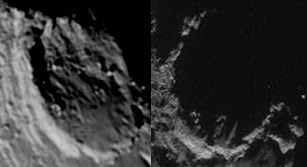 #2. The crater on Aug 15 appears to have a shallower depression. While the crater wall on the left shows shadowing, the remaining area of the crater doesn't appear to be much lower. But, when you compare it to the Sep 7 image, a few things stick out. A few features on the lower section of the crater while appear smooth, indicate three raised ridges. Additionally, a single ridge on the upper left of the crater on Sep 7 shows a wall high enough to cut through the edge of the crater, and high enough to capture an illuminated slope on the sunward side cutting through shadowed crater floor.
 #3.Yet again, areas that while are on the edge and would begin to wrap around the edge of the comet, seem to appear more level ground. But, due to the angle of the shadowing, crater edging seems to appear as the image wraps around the side.
 #4. Using a bit of trigonometry by knowing the angle of the sun to the object, and knowing some bit of measurements such as the length of the shadow itself, you may be able to calculate the height of a peak from a crater. But, some of that information may not be available. If someone with a bit more trig experience wants to give it a go, I think it would be possible with a bit of digging for angle and distance numbers to find its height. What is interesting is the drastic change between the length of the Sep 7 peak (left) on the left and the peak shadow on the right as well as the second step the appears nearly halfway down the slope. Now, as the area of illumination on the side of the formation side seems to be relatively the same amount of area on both days, the height may be quite shorter, relatively then observed. But as we are looking nearly straight down it would be hard to really visualize the the height. But, as observed, the shadow on Sep 7 seems to give hint to the real topography of the area.
 #5. Just like with #4, a lack of shadowing can be deceiving in regards to land structure. Apparently, the edge of this crater/field is higher then originally observed, as it casts a quite uneven edge shadow hinting at the structure of this edge. What is quite interesting is the deep in the middle showing two tall peaks that are completely invisible in the Aug 15 (left) image.
 #6. While it may simple be a visual illusion, there seems to be a boulder propped on the edge of the hill/crater edge. You can see it in the Aug 15 image both on the top of the wall, and rising higher then the top of the rim in the shadow. The shape and protrusion with a squarish top to it would seem to be an independent object from the shape of the rim edge itself.
 #7. This section of the crater field may give indication to the comet activity. It doesn't seem to give the typical signs of showing a crater edge. Although, visually, the right side is the higher smooth ground, while the crater evenly dips down into the other smoother field. My question is, what would make for smooth surface? I would suspect it is similar to what occurs on the moon for the Mare. The Mare are flooded (by volcanic erupted basalt) impact craters. While
the interior of the Moon was still hot an molten, asteroid or comets hit
the moon and created impact craters. Lava from the Moon's interior then
welled up to flood these craters, making the Mare. But, would a comet once have an interior like this? If so, these comet mare would be much older then the surrounding overlaying caters. Instrument investigations indicate that there is very little near surface ice, so these Mare would not seem to be formed by ice. Is this a remnant of the comets ancient hotter period?
#7. This section of the crater field may give indication to the comet activity. It doesn't seem to give the typical signs of showing a crater edge. Although, visually, the right side is the higher smooth ground, while the crater evenly dips down into the other smoother field. My question is, what would make for smooth surface? I would suspect it is similar to what occurs on the moon for the Mare. The Mare are flooded (by volcanic erupted basalt) impact craters. While
the interior of the Moon was still hot an molten, asteroid or comets hit
the moon and created impact craters. Lava from the Moon's interior then
welled up to flood these craters, making the Mare. But, would a comet once have an interior like this? If so, these comet mare would be much older then the surrounding overlaying caters. Instrument investigations indicate that there is very little near surface ice, so these Mare would not seem to be formed by ice. Is this a remnant of the comets ancient hotter period?

#8. Even such a drastic angle of the sun, the "head" of the comet disappears. The only surface that remains is the "body" as its wrapping edge ends at the terminating shadow edge. You would not guess that with just a bit of change in the suns angle that a completely other piece of terrain exist nearby.
On August 15, 2014 an image of the comet that appears to be the end of the section typically designated as the "body." The sun was at an angle nearly straight on causing short shadowing on the surface. Only in areas with high crater walls were the effects of the shadows drastically present. A part of the comet typically called the "head" of the comet is seen in the distance past the "body" section on the left side of the lower left of the image.
#1. On the Aug 15 image, the 8 boulders that are present in the oblong crater appeared to be low to the surface with broader structures. But, in the Sep 7 image made them appear to be taller then expected. While the field of view (FOV) of the NAVCAM is slightly more over head, their shadows just light with the local peaks of the craters are quite long. Although, their shapes seem to indicate the rocks to be a bit less round at their tops. While the shadows do elongate the shape of the object, they do help aid in identifying their basic shape. In fact one, the lower left of the right three boulders appear to be more wedge shaped.#2. The crater on Aug 15 appears to have a shallower depression. While the crater wall on the left shows shadowing, the remaining area of the crater doesn't appear to be much lower. But, when you compare it to the Sep 7 image, a few things stick out. A few features on the lower section of the crater while appear smooth, indicate three raised ridges. Additionally, a single ridge on the upper left of the crater on Sep 7 shows a wall high enough to cut through the edge of the crater, and high enough to capture an illuminated slope on the sunward side cutting through shadowed crater floor.#3.Yet again, areas that while are on the edge and would begin to wrap around the edge of the comet, seem to appear more level ground. But, due to the angle of the shadowing, crater edging seems to appear as the image wraps around the side.#4. Using a bit of trigonometry by knowing the angle of the sun to the object, and knowing some bit of measurements such as the length of the shadow itself, you may be able to calculate the height of a peak from a crater. But, some of that information may not be available. If someone with a bit more trig experience wants to give it a go, I think it would be possible with a bit of digging for angle and distance numbers to find its height. What is interesting is the drastic change between the length of the Sep 7 peak (left) on the left and the peak shadow on the right as well as the second step the appears nearly halfway down the slope. Now, as the area of illumination on the side of the formation side seems to be relatively the same amount of area on both days, the height may be quite shorter, relatively then observed. But as we are looking nearly straight down it would be hard to really visualize the the height. But, as observed, the shadow on Sep 7 seems to give hint to the real topography of the area.#6. While it may simple be a visual illusion, there seems to be a boulder propped on the edge of the hill/crater edge. You can see it in the Aug 15 image both on the top of the wall, and rising higher then the top of the rim in the shadow. The shape and protrusion with a squarish top to it would seem to be an independent object from the shape of the rim edge itself.#7. This section of the crater field may give indication to the comet activity. It doesn't seem to give the typical signs of showing a crater edge. Although, visually, the right side is the higher smooth ground, while the crater evenly dips down into the other smoother field. My question is, what would make for smooth surface? I would suspect it is similar to what occurs on the moon for the Mare. The Mare are flooded (by volcanic erupted basalt) impact craters. While
the interior of the Moon was still hot an molten, asteroid or comets hit
the moon and created impact craters. Lava from the Moon's interior then
welled up to flood these craters, making the Mare. But, would a comet once have an interior like this? If so, these comet mare would be much older then the surrounding overlaying caters. Instrument investigations indicate that there is very little near surface ice, so these Mare would not seem to be formed by ice. Is this a remnant of the comets ancient hotter period?#8. Even such a drastic angle of the sun, the "head" of the comet disappears. The only surface that remains is the "body" as its wrapping edge ends at the terminating shadow edge. You would not guess that with just a bit of change in the suns angle that a completely other piece of terrain exist nearby.
Friday, September 5, 2014
30 Days of comet 67P/C-G
Launching in 2004, and traveling for the last 10 years of an estimated 12 year voyage, the Rosetta orbiter has conducted gravity assist after gravity assist flyby maneuvers with the Earth and Mars as it traveled around the sun during its long mission to eventually rendaveau with, orbit around, and land "the Jupiter-family comet 67P/Churyumov-Gerasimenko with a combination of remote sensing and in situ measurements". On August 6th, 2014 it finally arrived at the comet and immediately got to work. As it approached the comet on August 1, 2014 it began a sequence image capture that included a composite animation of 101 of them, using its NAVCAMs (Navigation Cameras) as it continued to approach.
On August 6th as it arrived in orbit about the come, it began its Global Mapping of the surface which continued through August and into September. The images, using OSIRIS aboard Rosetta were captured in full from as it slowly orbited closer and closer to the tumbling mass of cosmic collisions. It is observed of course that the comet itself was formed by the collision of two other objects, that connected and fused at the "neck" area of the comet itself which gives it its odd "duck bill look."
Unfortunately, as Rosetta has moved closer to the comet, 50km as of August 23, instead of being able to capture a full frame of the comet, it began capturing only 1/4 segments to still allow for mapping of the object. These new segments were released on September 1st, allowing the image processing community the ability to create composites of a few that had been captured on August 31st. The second of these four-part images were released on September 4th of a sequenced captured on the 2nd.
On the August 31st images, a plume of what appears to be dust or some sort of out-gassing is seen originating from the "neck" narrow section of the comet.
The following animation is a complete sequence of the released full frame images from August 6 to the 23rd, and the composite images I have been splicing together from September 1st through the 4th.
While these images are captured days apart, it is interesting to see how the comet itself continues to tumble about its wobbly rotation.
 |
| ESA/Rosetta/NAVCAM/animation by Errol Coder |
Thursday, September 4, 2014
Venting captured from comet 67P/C-G
Their first set of images were released September 4th of the images captured on the 2nd. At a distance of 56kms, four images were captured, approximately 20 minutes apart as the capture changes its angle. The comet is also rotating on its axis at this time. So not only are the images captured minutes apart, but the view of the surface features also change position.
It takes a bit of twisting and adjusting to stitch the four images together to create a cohesive composite of the combined images. But, when done correctly, you can reveal some great features on the surface, and also other interesting occurrences.

 |
| click image to enlarge |
 | |
| click image to enlarge |
Sunday, August 24, 2014
Close Encounter with Saturn's Moon Titan
 |
Image Credit: NASA/JPL/Space Science Institute/ composite by Errol Coder |
Thursday, May 16, 2013
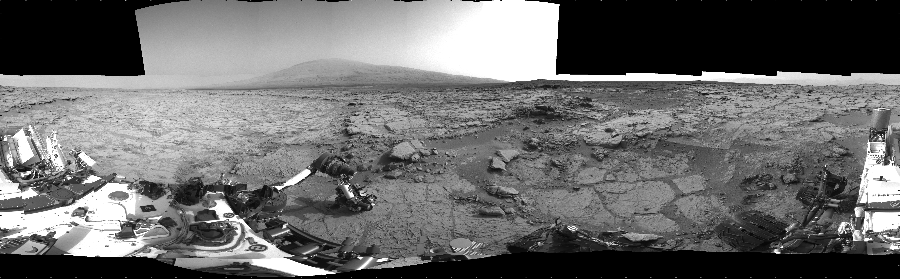
360 Panorama of Mt. Sharp by Curiosity
 |
| NASA/JPL-Caltech
click image to enlarge |
Titan before Flyby
On May 14, 2013 Cassini captured a series of images of Titan at a distance as it prepares for its flyby on May 23, 2013. This is a False color composite using Cassini's CB3, MT3 (methane), and UV3 (ultra-violet) filters. You can clearly see the methane atmosphere, and the collection of the green hue at Titan's northern pole. Using the CB3 filter, it allows us a glimpse through Titan's thick atmosphere, and see aspects of the surface.
 |
| NASA/JPL-Caltech/Space Science Institute/composite by Errol Coder click image to enlarge |
Subscribe to:
Posts (Atom)