Thursday, May 16, 2013

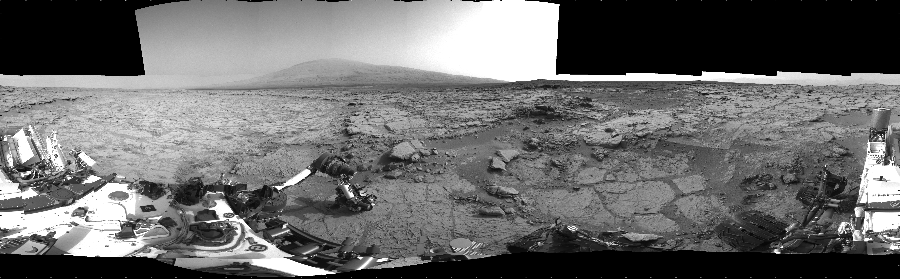
360 Panorama of Mt. Sharp by Curiosity

NASA/JPL-Caltech
click image to enlarge
NASA's Mars rover Curiosity took 40 images in Gale Crater using its mast-mounted Left Navigation Camera (Navcam) to create this mosaic. The seam-corrected mosaic provides a 360-degree cylindrical projection panorama of the Martian surface centered at 180 degrees azimuth (measured clockwise from north). Curiosity took the images on January 26, 2013, Sols 168-169 of the Mars Science Laboratory mission at drive 0, site number 6. The local mean solar time for the image exposures was from 3 PM to 4 PM. Each Navcam image has a 45 degree field of view.

Titan before Flyby

On May 14, 2013 Cassini captured a series of images of Titan at a distance as it prepares for its flyby on May 23, 2013. This is a False color composite using Cassini's CB3, MT3 (methane), and UV3 (ultra-violet)  filters. You can clearly see the methane atmosphere, and the collection of the green hue at Titan's northern pole. Using the CB3 filter, it allows us a glimpse through Titan's thick atmosphere, and see aspects of the surface.

NASA/JPL-Caltech/Space Science Institute/composite by Errol Coder
click image to enlarge

Monday, March 4, 2013

Color Contrast of Saturn

click image to enlarge
On February 28, 2013 on its way to a flyby of Saturn's moon Rhea, Cassini captured images of the face Saturn using its Continuum band 2 and Methane band 2 filters. This is a two image composite of those two shots. Using the methane filter you can see the detail in the swirling gas layers that you would often see at Jupiter. This is a false image of the atmosphere of Saturn to help show the distinctive differences in the coloration and to bring out the details in the methane gases. The planet is tilted so the top is at the top left.


NASA/JPL-Caltech/Malin Space Science Systems/ composite by Errol Coder
click image to enlarge

Monday, February 18, 2013

Curiosity Rover: Beautiful Mars Panorama

Image Credit: NASA/JPL-Caltech/Malin Space Science Systems/ composite by Errol Coder
click image to enlarge
On February 15, the Curiosity Rover (MSL) captured this Panorama of its current investigation location. This imaged was spliced together using 18 panoramic images captured by the Left Mast Cam on board the Mars Science Laboratory. In this image the filters have already been applied and color corrected on board the rover itself before being transmitted back to Earth. This view stretches from the NE at the edge of Mount Sharp to the NW along the crater rim.

Sunday, February 17, 2013

Titan Flyby: Eclipsed

Credit: NASA / JPL / SSI / composite by Errol Coder
click image to enlarge

 
The first images from Cassini are coming in from the flyby on February 16. These first images were taken approximately 173,902 miles (279,868 kilometers) away using the RED, GRN, BLU filters. It is the Methane filters that typically bring out the detail in atmosphere and surface. As Cassini flies by hopefully we will see those filters used to help bring out the detail. But,we can see right now is the Methane atmosphere coming in as blue along the edge of Saturn's larges moon. Once the new images are received, I will be processing them and posting. Look forward to some gorgeous images!

Saturn's Rings in all its Detail

Credit: NASA / JPL / SSI
Many of the images I process are captured using many of the filters that the Cassini has aboard. These images can be layered for the particular connected RGB colors, to bring forth some brilliant shots. This image is different. This is the original high res image captured on February 15th. This set of images were taken with the clear filters. Simply put, it is beautiful in itself. you can see great detail the separations in the rings.

The A-Ring is to the right of the Cassini Division, which is the separation you see to the ride side of the image with the B-Ring to the left of it.

Friday, February 15, 2013

Color Composite of Saturn's outer rings

Credit: NASA / JPL / SSI / composite by Errol Coder
On February 13, 2013 the Cassini spacecraft completed a flyby of Saturn's rings capturing a long series of images as it passed above it. In this image, using the RED, BLU, and GRN color filters a false color of the image was formed to show the detail int he different rings. The outer F-Ring (white) can be clearly seen with the large divide between it and the A-Ring.